The Permit Secret: Bypassing the 664-Day Backlog in 2026
The 2026 Gridlock: Why Your Neighbors Are Waiting
(And You Aren't)
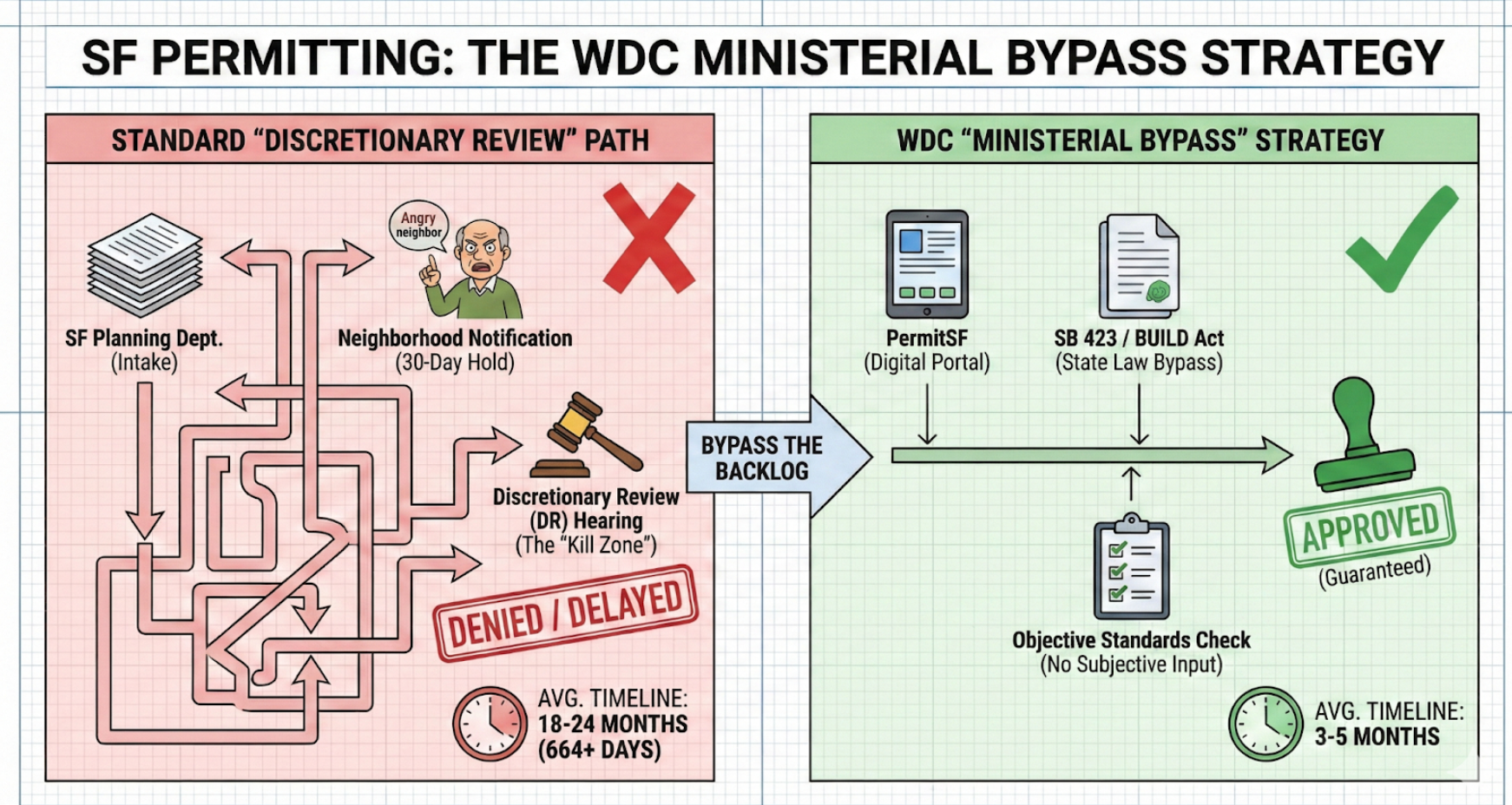
If you ask the average San Francisco contractor how long a full-home remodel permit takes, they'll give you a cynical laugh and say "Two years." For most, that's the reality. As of January 21, 2026, the average queue for an in-house review at the Department of Building Inspection (DBI) hit a staggering
664 days. This "Permit Purgatory" has historically been where luxury projects go to die — trapped in a cycle of Discretionary Review and bureaucratic hand-offs.
But here is the secret that most 50-person construction firms haven't learned yet: the "Line" at 49 South Van Ness is now largely optional for those who understand the new digital gate. At We Do Construction (WDC), we have spent the last quarter migrating our entire pre-construction workflow into the City's brand-new digital infrastructure. We don't just "apply" for permits — we engineer them for the
February 13, 2026 PermitSF Portal bypass.
The homeowners who moved fastest in Q1 2026 weren't the ones with the most connections. They were the ones whose contractors understood three specific regulatory levers. This post breaks them down — and explains a 2027 infrastructure mandate that should be on every 2026 permit filing right now.
The "Digital In-Kind" Fast-Track
(The 48-Hour Approval)
Most homeowners make the mistake of viewing a remodel as one giant permit. They wait until every cabinet pull is selected before filing. In the 2026 regulatory environment, that is a tactical error.
WDC utilizes Parallel Track Permitting. While your major structural plans are winding through the secondary review queues, we leverage the PermitSF Digital In-Kind Replacement path.
- The Scope: We separate the "Enclosure" phase — doors, windows, siding, and roofing — from the internal structural work.
- The Speed: Because these are "In-Kind" replacements that don't alter the building's footprint, the new portal allows for a 48-hour digital approval.
- The Result: On a typical $800K Victorian modernization, we can have crews on-site doing demo and exterior restoration months before the internal structural permit is even assigned to a reviewer. We keep the project moving while the rest of the City sleeps.
This is not a workaround — it is the intended use of the portal. The City built the In-Kind path specifically to decongest the counter. Firms that batch all work into a single permit filing are leaving months of calendar time on the table.
The In-Kind path is particularly powerful on the Victorian and Edwardian stock that defines neighborhoods like Noe Valley and Pacific Heights. If you're planning a structural open-concept conversion alongside an exterior restoration, the two scopes can be permitted in parallel — see our breakdown of
how we engineered an open-concept Victorian in SF without touching the original facade for a live example of this sequencing.
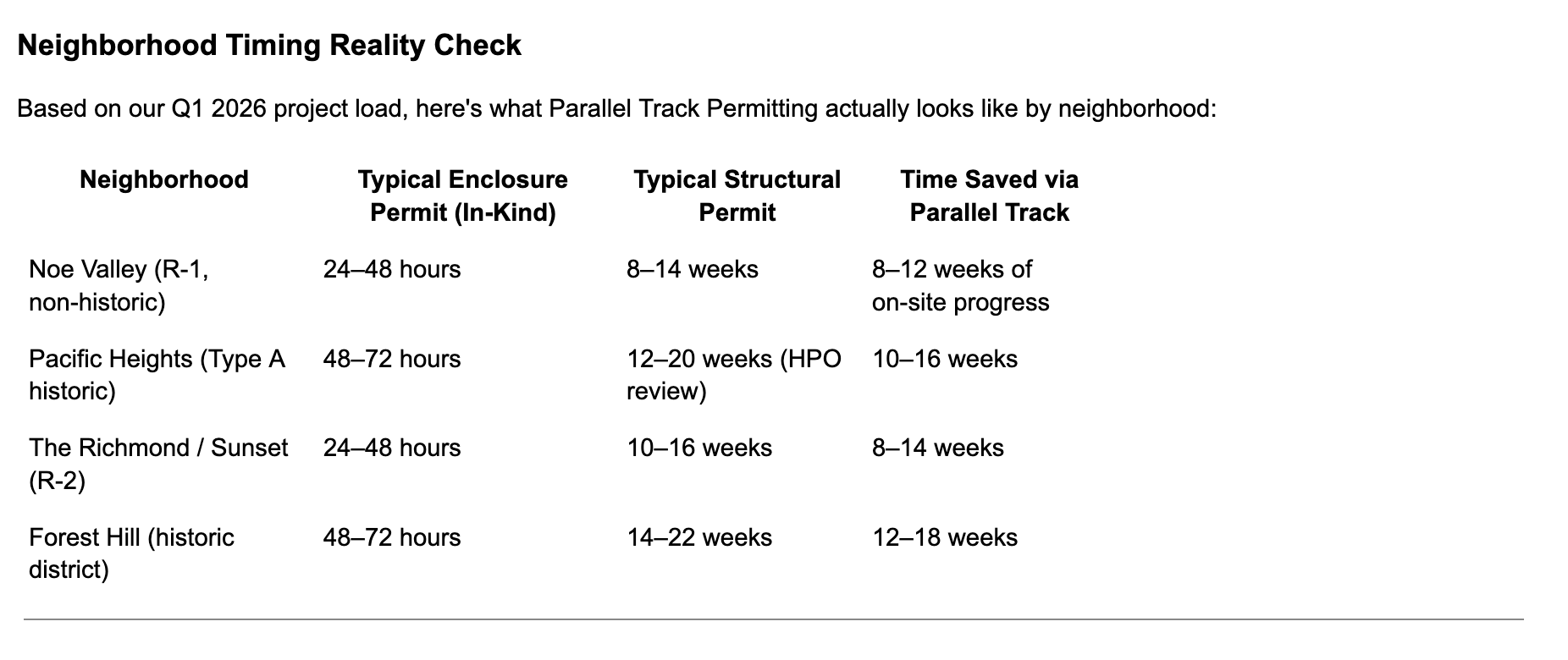
Neighborhood Timing Reality Check
Based on our Q1 2026 project load, here's what Parallel Track Permitting actually looks like by neighborhood:
Navigating the BUILD Act's "Minor Modification" Clause
One of the biggest "Budget Killers" in San Francisco construction has always been the "Structural Surprise." You open up a 100-year-old wall, find a rotted header, and realize you need to move a window six inches to save the building's integrity. Under the old rules, that "Minor Change" could trigger a "Re-Entitlement" process, resetting your 664-day clock and costing $20,000 in architect revisions.
On February 26, 2026, Mayor Daniel Lurie introduced the Balanced Update to Incentivize Local Development (BUILD) Act. This is the single biggest win for homeowners in a generation.
The BUILD Act eliminates the mandatory public hearing requirement for "Minor Modifications" to existing permits. By working with a boutique firm that understands the specific "Objective Design Standards" of the
San Francisco Planning Code Section 311, we can submit these changes digitally in real-time. We've seen this save our clients an average of
120 days of idle "Down Time" on-site.
What Qualifies as a "Minor Modification" Under the BUILD Act?
The BUILD Act's scope covers changes to approved permit plans that do not increase gross floor area, do not exceed 10% deviation from approved dimensions, and do not alter the building's exterior envelope in a way that triggers Section 311 neighbor notification. In practical terms, this means:
- Structural header adjustments discovered during demolition
- Window and door opening shifts of less than 12 inches from approved location
- Load path modifications that don't change floor-area ratio
- Plumbing and mechanical routing changes within approved chase locations
The key is having a contractor who documents wall discoveries at the point of finding — not at invoice — and files the digital modification the same day. At WDC, that is a standing protocol on every job.
The "Housing Choice-SF" Ministerial Loophole
The January 2026 Family Zoning Plan has changed what you can build on a standard R-1 lot. But the real "Permit Secret" isn't what you build — it's how you file it.
We aim for Ministerial Approval rather than "Discretionary Review." By utilizing the Housing Choice-SF (HC-SF) local bonus program, we can often trigger the SB 423 Ministerial Review Path.
- The 90-Day Guarantee: Under SB 423, the Planning Department is legally held to a 90-day review timeline for projects that meet specific objective standards.
- The WDC Edge: Most generalist GCs design for "Aesthetics first, Code second." We design for "Entitlement Velocity." We ensure your multi-unit compound or high-end ADU hits the ministerial triggers so your neighbors don't get a chance to tie your project up in a discretionary hearing.
The ministerial path is especially powerful for ADU and condo-conversion projects, where neighbor DR exposure can kill project economics entirely. If you're considering adding a unit to your SF property, our guide on
ADU and condo conversions in San Francisco — what's actually possible on your lot in 2026 walks through the exact HC-SF triggers by zone type.
The "Zero-NOx" Infrastructure Mandate: A 2026 Warning
Every permit we pull in 2026 is governed by the 2025 California Building Standards Code (Title 24, Part 6). But more importantly, we are building with an eye on January 1, 2027.
As of that date, BAAQMD Rule 9-6 will make the sale of natural gas water heaters illegal in the Bay Area.
Why this affects your 2026 permit: if your contractor isn't pulling a 400A Service Upgrade permit today, they are building you a kitchen that will be functionally obsolete in 10 months. We integrate "Electric-Ready" infrastructure into our initial permit filings to ensure that when the 2027 "Gas Cliff" hits, your home's resale value remains insulated. A home that cannot support a Zero-NOx heat pump will be a "Hard-to-Sell" asset in the 2027 San Francisco market.
This isn't a minor compliance footnote — it is a material resale risk for any Pacific Heights or Noe Valley home that closes renovation without electric-ready infrastructure. We've written a full breakdown of
what BAAQMD Rule 9-6 means for SF homeowners and how to future-proof your project before the January 2027 deadline.
The Panel Upgrade Calculation
A 400A panel upgrade added as a line item to your existing permit costs approximately $18,000–$28,000 depending on service distance. Added as a standalone permit after project completion, the same work costs $35,000–$55,000 due to re-opening walls, redundant inspection fees, and PG&E coordination delays. The math is simple: pull it now, in the same permit window.
Boutique Intelligence vs. Big Box Bureaucracy
At We Do Construction, we are a 10-person firm. We don't have a floor of cubicles or a fleet of branded trucks — we have Jacob and a high-signal technical team.
The "Permit Secret" isn't about knowing someone at City Hall; it's about knowing the API of the City. We utilize the PermitSF Digital Portal like a FAANG engineer utilizes a codebase. We understand that in 2026, the fastest way to build a luxury home in San Francisco is to navigate the "Science" of the digital portal without losing the "Soul" of the historical neighborhood.
If you are a legacy homeowner in Noe Valley, Pacific Heights, or the Sunset, and you've been told "it will take two years," you're talking to the wrong people. The 2026 rules have changed. Let us show you the new digital fast-track.
Permits are the foundation — not the ceiling. For homeowners thinking about how a 2026 renovation fits into a longer-term wealth strategy for their SF property, see our complete guide to building a wealth compound through SF real estate.
Frequently Asked Questions
How long does an SF remodel permit actually take in 2026?
The DBI standard queue hit 664 days in January 2026. The PermitSF Digital In-Kind path approves in 48 hours for qualifying enclosure work. Projects structured for SB 423 ministerial review are legally guaranteed a 90-day timeline. The "two years" answer is for firms that don't know the difference.
What exactly does the BUILD Act change?
Signed February 26, 2026 by Mayor Lurie, the BUILD Act eliminates mandatory public hearings for minor permit modifications. Field changes — header adjustments, window shifts, mechanical reroutes — that previously triggered re-entitlement can now be submitted digitally in real time. Average savings: 120 days and $20,000 in architect fees.
Do I need a 400A panel upgrade if I'm not doing a full kitchen gut?
If your project touches the kitchen at all — new appliances, lighting circuit, island with outlets — the answer is yes, pull it now. BAAQMD Rule 9-6 takes effect January 1, 2027. A home without electric-ready infrastructure will be a harder sell in the 2027–2028 SF market. The cost delta between pulling it concurrently vs. standalone is $17,000–$27,000.
What's the difference between discretionary review and ministerial approval?
Discretionary Review lets neighbors and the Planning Commission challenge your project — timeline is unlimited. Ministerial approval is non-discretionary: if you meet objective standards, the City must approve within 90 days (SB 423). WDC designs to ministerial triggers from day one, not as an afterthought.
Can any contractor use the PermitSF digital portal?
The portal requires a licensed contractor or architect account. Filing accuracy matters — an incomplete In-Kind application can be rejected, resetting to paper queue timelines. WDC has processed 12+ portal filings since the February 13, 2026 launch date.
Ready to work with We Do Construction?
Let's connect! We’re here to help.
Send us a message and we’ll be in touch.
Or give us a call today at 415-416-5494
Agency Contact Form
More Construction Tips, Tricks & Tools